
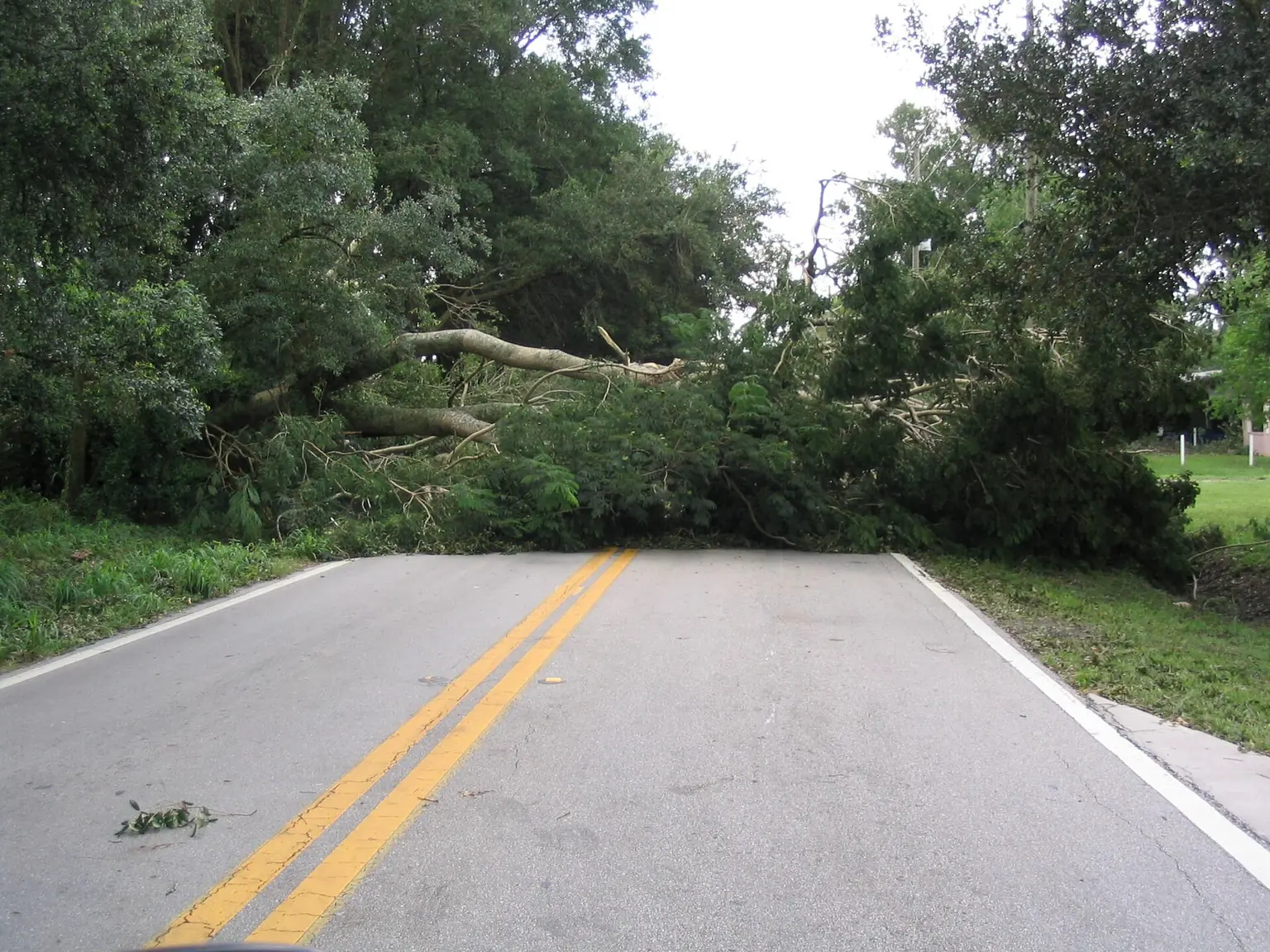
Photo: Road photo from August 15, 2004 22 by NE2, CC0, via Wikimedia Commons
A debris pile near overhead or ground-level utility equipment can complicate removal and create avoidable hazards. There is no single distance that fits every Florida property, utility configuration, pile type, or pickup method. The safest decision is to keep debris well away from lines and utility equipment, preserve clear access, and ask the appropriate utility provider or local authority when the correct placement is uncertain.
Do Not Rely on One Universal Distance
Property owners often want a simple number, but pile placement requires more than measuring from the nearest pole. Overhead lines may cross a driveway, yard, roadside area, or intended loading path. Utility poles can also carry multiple lines at different heights. At ground level, meters, cabinets, transformers, pedestals, guy wires, and marked underground facilities may affect where debris can be staged.
Because these conditions vary, a distance that appears generous on one property may still leave an unsafe or impractical approach on another. Do not assume a line is insulated, inactive, or harmless because of its appearance. Never place debris against a utility pole, beneath sagging lines, around guy wires, or in front of utility equipment that workers may need to reach.
When placement is unclear, contact the utility provider or relevant local authority before building the pile. Their direction should take priority over a convenient staging spot. If a line is down, damaged, or unusually low, keep people away and report it rather than moving debris nearby.
Evaluate the Space Above and Around the Pile
Begin by looking upward from several positions, not only from the center of the planned pile. Identify every overhead line near the debris, the route used to reach it, and the space where loading activity could occur. A pile may sit beside a clear patch of ground while still being directly below a line that is difficult to see through branches or against a bright sky.
Next, consider how the pile could change. Loose limbs, brush, and irregular material can shift, roll, or extend beyond the original footprint. Wind and rain can also alter a loosely arranged pile. Leave more room than the pile appears to need at the moment it is created.
Keep children, visitors, and pets away from utility-adjacent debris. Do not climb on the pile, lift long branches toward overhead lines, or try to pull material away from a line. If any debris is touching or entangled with a utility line, stop. Contact the utility provider for instructions instead of attempting to separate it yourself.
Protect Ground-Level Equipment and Access
Safe placement involves more than overhead clearance. Walk around the proposed staging area and identify equipment or access points that debris could hide or block. Vegetation and storm debris can quickly cover small pedestals, wires, markers, or cabinets, making them harder to recognize later.
Use this practical check before adding material:
- Look above the pile, beside it, and along the full access route.
- Keep poles, guy wires, meters, cabinets, transformers, and pedestals unobstructed.
- Preserve access to driveways, gates, sidewalks, roads, and utility equipment.
- Avoid covering utility markings or placing stakes into the ground without appropriate guidance.
- Keep debris stable, visible, and contained within the chosen area.
- Stop adding material if the pile begins spreading toward a line or piece of equipment.
Do not move a cabinet, marker, wire, or other utility component to create space. Also avoid placing debris where someone would have to stand beside utility equipment to sort or rearrange it. If underground work, digging, or staking is involved, obtain the appropriate utility-location guidance before disturbing the soil.
Plan for the Entire Pickup Approach
A clear pile is only one part of the decision. The route leading to it also matters. Review the entrance, driveway, roadside edge, gates, parked vehicles, trees, fences, mailboxes, and overhead lines. Think about turns and approach angles rather than assuming that an open-looking yard provides usable access.
Keep the debris consolidated in an accessible area without forcing activity beneath lines or next to utility equipment. Do not place the pile where access would require crossing a soft shoulder, blocking traffic, or moving through a narrow gap without first discussing the site. Avoid mixing the pile with objects that could shift unexpectedly or make its edges difficult to identify.
Preparation also affects the questions you should ask about pricing. Pile size, material arrangement, access, and site conditions may all be relevant to a discussion. For a broader planning overview, read about grapple truck pickup cost factors. Share accurate site details instead of relying on a rough visual estimate from the street.
What to Do When the Location Is Uncertain
If every convenient staging area appears close to a utility line or utility equipment, pause before creating the pile. Take note of where the lines run, which ground-level components are present, and how access reaches the area. Photos taken from multiple angles can help explain the layout during a phone conversation, but they do not replace instructions from a utility provider or an on-site assessment when one is needed.
Separate immediate electrical concerns from routine placement questions. A fallen line, sparking equipment, damaged pole, or debris touching a line calls for distance and prompt reporting to the proper utility or emergency authority. Routine questions concern where an untouched pile can be placed while preserving clearance and access.
Do not guess, handle utility equipment, or use tools near a questionable line. Choose a different location when possible. If no clearly suitable area is available, gather the property details and ask before moving more material. A short planning conversation can prevent repeated handling and help identify information still needed.
Discuss Your Debris Pile Location
For a calm conversation about your debris pile and site access, call Daytona Grapple Trucks at (386) 481-7913. Describe nearby lines, utility equipment, gates, and the proposed access route so the situation can be discussed clearly.
Call (386) 481-7913 to talk through next steps.