
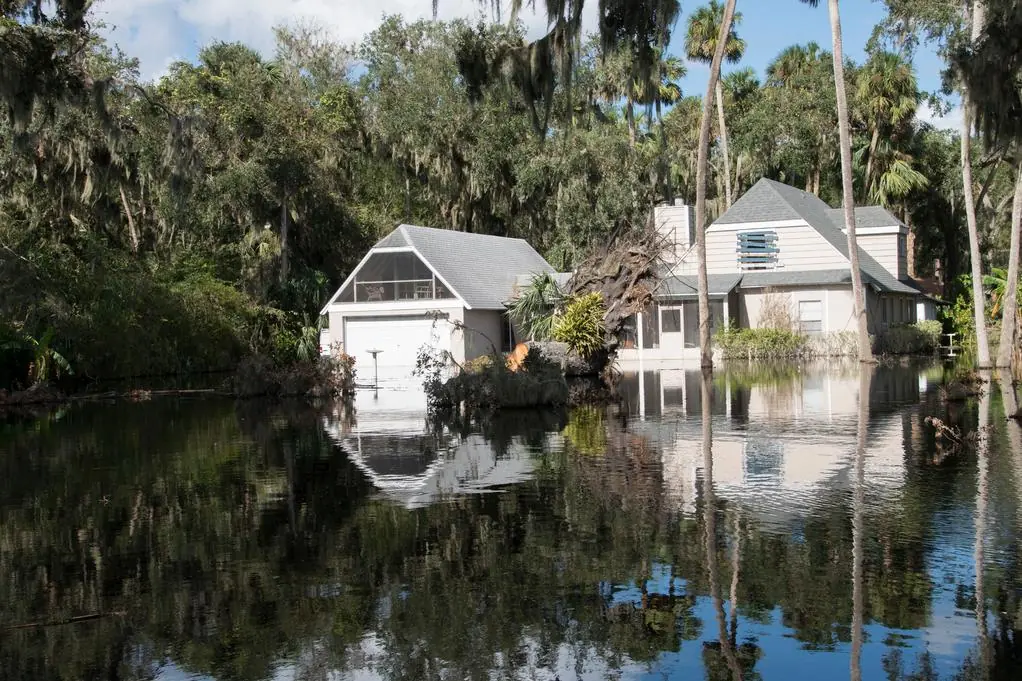
Photo: FEMA - DR4337 Water engulfs yards at Deltona, Florida, home in Volusia by Patsy Lynch/FEMA, Public domain, via Wikimedia Commons
Soft or saturated ground can complicate debris pickup because a heavy truck needs a stable route, a workable position, and enough room to leave safely. Before arranging a grapple truck pickup in Florida, evaluate the property after recent rain, identify firm access, and explain the conditions clearly. The practical question is not simply whether debris can be reached. It is whether the truck can approach, work, and exit without creating avoidable problems.
Start With Ground Conditions, Not Debris Volume
Begin by walking the proposed access route if it is safe to do so. Look for standing water, deep tire impressions, loose sand, mud, softened shoulders, and areas where your feet sink. These signs can help you describe current conditions, although they do not replace an on-site judgment about access.
Conditions may vary across one property. A paved driveway can lead to a soft yard, or a firm entrance can narrow beside a ditch or drainage area. Note each transition between surfaces. Also consider whether recent rain is still draining through the site and whether additional rain is expected before pickup.
Take clear photos from the entrance toward the debris and from the debris back toward the exit. Include wide views that show turns, overhead space, and nearby structures. When you call Daytona Grapple Trucks, this information can support a more focused conversation about whether the proposed setup appears workable.
Identify a Firm Route and Work Position
A grapple truck needs more than a path that looks passable from a distance. The route should be considered along its full length, including the entrance, turns, stopping area, and exit. Pay special attention to soft edges where a tire could leave pavement, areas recently filled with soil, and surfaces that may conceal saturated ground beneath grass.
The intended work position matters because the truck may need to remain in place while debris is collected. A route that can be crossed slowly may not provide an appropriate place to stop and work. Avoid assuming that lawn, sand, or compacted-looking soil will support the same use as pavement or another visibly firm surface.
Measure or estimate narrow points and photograph gates, fences, trees, rooflines, and utility lines. Do not move markers or alter drainage features merely to create access. Instead, provide an accurate description and ask what information is needed to evaluate the route and work area.
Place Debris With Access in Mind
If debris has not yet been staged, avoid placing it in the wettest part of the property. A pile positioned closer to a firm, accessible surface may reduce the need for the truck to enter soft ground. However, placement should not block traffic, drainage, sidewalks, gates, or another necessary access point.
Keep these practical steps in mind when selecting a staging area:
- Choose the firmest reasonably accessible location available.
- Keep the route between the entrance and pile clear.
- Leave room around the pile rather than packing it against a structure.
- Check above the area for branches, wires, and roof overhangs.
- Avoid low spots where water collects after rain.
- Photograph the pile and the complete approach before calling.
If the debris is already on soft ground, do not relocate it without first considering safety and property damage. Explain where it is, how far it sits from a firm surface, and what lies between the entrance and the pile.
Use Timing to Reduce Uncertainty
Ground conditions can change between scheduling and arrival. A yard that begins drying may soften again after another storm, while visible surface water may disappear before the soil beneath has firmed. For that reason, provide the most current information available rather than relying on how the property looked several days earlier.
Check the proposed route again near the planned pickup. If conditions have changed, take updated photos and call before the truck arrives. Mention new standing water, rutting, blocked access, fallen branches, or any activity that has disturbed the ground. Early notice allows the situation to be discussed without assuming that the original plan remains suitable.
Waiting for better conditions may be worth discussing when the only approach crosses saturated soil. The decision depends on the actual property and current access. Daytona Grapple Trucks can discuss the information you provide, but no general article can determine whether a particular soft-ground route is appropriate.
Prepare Useful Details Before You Call
A concise, accurate description helps make the initial call productive. Start with the debris location relative to a firm driveway, road, or other accessible surface. Explain whether the proposed route is paved, gravel, sand, grass, soil, or a combination. Mention recent rain and any standing water or visible rutting.
Also describe obstacles such as gates, tight turns, trees, fences, structures, drainage areas, and overhead lines. State whether the debris can be staged elsewhere, but do not promise to move it until the alternative location has been considered. Photos taken from several angles can clarify details that are difficult to explain by phone.
Cost questions may involve more than ground condition. For a broader planning overview, read about grapple truck pickup cost factors. When discussing your property, keep access and pricing questions separate enough to address both clearly. Accurate site details support a practical conversation without assuming availability, suitability, or a specific outcome.
Discuss Your Pickup Conditions
For a calm, direct conversation about debris location, access, and soft or saturated ground, call Daytona Grapple Trucks at (386) 481-7913. Have current photos and a description of the route ready.
Call (386) 481-7913 to talk through next steps.