August 22, 2026
Narrow Holly Hill streets require careful preparation before debris hauling. Learn how to evaluate truck access, parked vehicles, sight lines, overhead obstacles, boom reach, and curbside pile placement.
A successful grapple truck pickup on a narrow street begins with an access review, not just a debris estimate. For properties in the Holly Hill service area, screen the travel lane, turning space, parking, visibility, overhead clearance, boom reach, and pile location before confirming that the truck can work safely and efficiently.
Narrow does not automatically mean inaccessible. The practical question is whether a large hauling truck can approach the pile, stop in a workable position, operate without contacting nearby obstacles, and leave without backing through an unsafe or obstructed route.
When describing the site, provide the street name, nearest cross street, property type, driveway arrangement, and the side of the street where the debris will sit. Photos from both directions are useful because a view taken only from the pile may hide a tight turn, low branch, sign, or vehicle that affects the approach.
Daytona Grapple Truck Service is a hauling-only service based in Ormond Beach. It serves Volusia and Flagler counties and does not cut or remove standing trees. Tree limbs, brush, or other material must already be cut or cleared before hauling is arranged.
Turning room can determine whether grapple truck debris removal is practical at a constrained property. Before arranging service through the contact page, identify the truck's likely entrance, loading position, and exit route. A straight approach with a forward departure is generally easier to assess than a dead end, tight driveway, alley, or route requiring repeated backing.
Start beyond the immediate pile. Trace the likely route from the nearest wider road to the property. A truck may fit along the block but still have difficulty making the final turn because of parked cars, corner landscaping, utility poles, mailboxes, or vehicles positioned close to an intersection.
For a cul-de-sac or dead-end street, explain the available turnaround area and whether it is normally occupied. Do not assume a private driveway, neighboring lot, or commercial parking area can be used for turning. Access to private property should be authorized by the property owner, and surfaces must be suitable for the vehicle involved.
A practical route review should answer:
Street conditions can change between planning and pickup. A delivery vehicle, landscape trailer, or unexpected parking pattern may reduce usable space. Keeping the approach and departure areas clear helps preserve the access described during scheduling.
For a narrow Holly Hill block, local grapple hauling depends on a clear legal working area and adequate sight distance. Use the broader service-area information to confirm coverage, then evaluate parked cars, intersections, curves, driveways, and traffic flow. Do not reserve or block public space without checking requirements with the authority responsible for that street.
Parked vehicles reduce more than lane width. They can prevent the truck from positioning parallel to the pile, restrict the boom's working area, hide oncoming traffic, and make it difficult for other drivers to pass. Ask household members and authorized nearby vehicle owners to relocate vehicles that affect the loading zone, approach, or exit.
Visibility deserves special attention near corners and curved segments. Drivers approaching the work area should have enough distance to recognize the stopped vehicle and respond appropriately. Avoid placing debris where the pile itself blocks views from a driveway or intersection.
Responsibility for a road can vary. For information about state-maintained roads, consult the Florida Department of Transportation maintenance resources. Questions about traffic control, temporary obstructions, right-of-way use, parking restrictions, or local street requirements should go to the agency responsible for the specific roadway. Daytona Grapple Truck Service should not be treated as the authority on permits or traffic rules.
| Street condition | Why it matters | Preparation step |
|---|---|---|
| Cars on both sides | Reduces travel and operating width | Arrange authorized vehicle relocation where possible |
| Pile near a corner | Limits sight distance and turning room | Choose a more visible location if permitted |
| Busy through traffic | Complicates stopping and loading | Discuss conditions and contact the road authority if needed |
| Dead-end block | May require backing or a turnaround | Document the exit plan before scheduling |
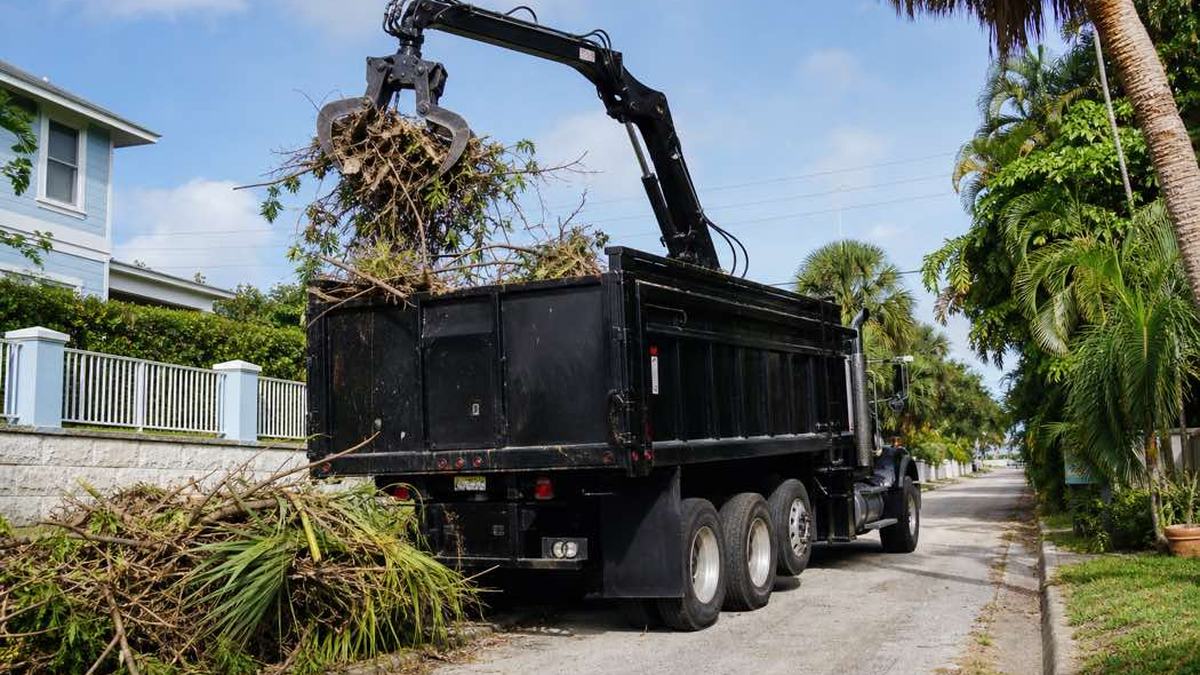
The boom must reach the debris from a suitable truck position without operating through avoidable obstacles. When planning grapple truck debris removal, share side-view photos through the service contact option that show the pile, curb, shoulder, wires, trees, signs, fences, and buildings. Final feasibility depends on the full site layout, not a single estimated distance.
Boom reach is not permission to place material behind anything convenient. A pile may appear close to the road but remain impractical if a fence, parked car, utility line, tree canopy, or roof edge occupies the working path. The safest plan usually provides an open route between the truck's loading side and the material.
Look upward as carefully as you look across the ground. Overhead electrical and communications lines, low limbs, service drops, decorative lights, signs, and building projections all matter. Never move, lift, or handle utility lines. If vegetation contacts or closely approaches utility infrastructure, contact the appropriate utility or qualified service provider for guidance.
Also check the vertical shape of the pile. Long branches that point toward traffic, wires, vehicles, or buildings can complicate loading. Cut material should be consolidated within the approved placement area, with protruding pieces oriented away from hazards when practical. Daytona Grapple Truck Service does not cut standing trees or perform tree removal, so cutting and clearing must be completed beforehand.
Helpful photos include a straight-on view from across the street, views looking both directions along the curb, a side profile showing pile height, and a wider image capturing overhead conditions. Include a familiar object for scale without placing a person in a hazardous area.
Good pile placement makes a grapple truck pickup on a narrow street easier to evaluate and reduces avoidable handling. Within the Holly Hill coverage area, place debris only where you are authorized to do so, keep it consolidated, and preserve access to hydrants, drains, mailboxes, sidewalks, driveways, intersections, and utility equipment.
Do not assume the strip between a sidewalk and roadway is automatically available for private debris placement. Property boundaries, easements, rights-of-way, drainage features, and local requirements vary. For current public solid-waste information, consult Volusia County Solid Waste and Recycling or the responsible municipal department. Those agencies do not endorse Daytona Grapple Truck Service.
Build a compact pile rather than a long windrow. A wide, scattered pile uses more curb frontage and may force the boom to work around multiple obstacles. Keep material out of the active travel lane unless the responsible authority has specifically allowed otherwise.
For storm-related debris, the FEMA debris removal guidance offers general preparation and separation concepts. Eligibility, reimbursement, collection, and placement requirements depend on the specific event and responsible agencies. Contact those authorities for current instructions rather than assuming private hauling is reimbursable or compliant with a public program.
Accurate material details help determine whether grapple truck hauling fits the job. Customers across the Volusia and Flagler service area should identify brush, logs, household debris, or construction material before pickup. Approved construction debris can be hauled only after confirmation, and no material should be assumed acceptable merely because it can be lifted by a grapple.
Send clear photos and describe how the material was produced. Tree debris should already be cut or cleared because the company is hauling-only. Mention unusually long, heavy, tangled, wet, burned, dusty, sharp, or bagged material. Also identify materials hidden beneath the visible top layer.
Mixing debris can create handling and disposal complications. Keep vegetative material separate from construction debris and household discards when possible. Set aside liquids, chemicals, batteries, fuel containers, pressurized cylinders, asbestos-suspect material, and other questionable items until the appropriate authority or receiving facility provides instructions.
The U.S. Environmental Protection Agency's disaster debris planning guidance explains why debris identification and separation matter after major events. It is general public guidance and is not an endorsement of this business. For acceptance or disposal questions, contact the responsible local agency or facility.
Use this pre-contact material checklist:
Daytona Grapple Truck Service has a 50-yard-capacity truck, but capacity does not establish an exact number of loads for a particular pile. Material density, shape, loading conditions, access, and accepted disposal arrangements all affect job planning.
Before the arranged visit, confirm that access still matches the conditions discussed for Holly Hill hauling service. Use the contact page to report new parking, utility work, road closures, gate issues, or added debris. The phone is answered 24/7, but that does not promise a particular appointment time, availability, or response time.
On pickup day, keep the loading area clear of people, pets, bicycles, toys, lawn equipment, and movable vehicles. Close nearby doors and windows if dust is a concern. Do not stand near the truck or beneath the operating boom, and do not attempt to guide equipment by entering its working area.
Recheck the pile after wind or rain. Loose branches may roll into the street, tarps can snag material, and saturated ground can change surface conditions. Remove personal coverings or tie-downs before service unless otherwise directed. If the pile changed substantially, provide updated photos.
A concise readiness check includes:
If site conditions prevent safe or practical positioning, the plan may need to change. Possible next steps include relocating the pile to an authorized accessible location, clearing movable obstacles, confirming a different approach, or consulting the responsible road authority. Avoid making last-minute changes to public-space use without authorization.
These answers summarize common planning points for grapple truck pickup on a narrow street. Property owners in the Holly Hill service area should still provide site photos and material details because street width alone does not determine access. The company hauls debris after cutting or clearing and serves locations in Volusia and Flagler counties.
Possibly. Feasibility depends on clear travel width, turning and exit space, parked vehicles, traffic visibility, overhead obstacles, boom reach, pile position, and surface conditions. Photos looking both directions along the street and showing the pile help with screening. Final access cannot be determined from the street name or curb-to-curb width alone.
Place it only in an authorized area that the truck can reach without avoidable interference from wires, trees, signs, fences, vehicles, or buildings. Keep hydrants, drains, sidewalks, mailboxes, driveways, utility equipment, intersections, and traffic lanes clear. Ask the responsible local authority about current right-of-way, placement, collection, permit, or code requirements.
No. Daytona Grapple Truck Service is a hauling-only service based in Ormond Beach. It does not cut or remove standing trees. Tree limbs, trunks, brush, and similar debris must already be cut or cleared and positioned for access before hauling. If cutting is needed, arrange that work separately before scheduling debris pickup.
Approved construction debris can be hauled after confirmation. Provide photos and identify materials such as wood, roofing, drywall, metal, concrete, or mixed renovation debris before scheduling. Do not add liquids, chemicals, pressurized cylinders, asbestos-suspect material, or other questionable items without specific confirmation and guidance from the appropriate disposal or regulatory authority.
The truck has a 50-yard capacity, but that figure should not be treated as an exact load count for a pile. Debris density, shape, moisture, compaction, material acceptance, boom access, and safe loading all affect planning. Share measurements and photos for review rather than estimating service needs from capacity alone.