August 21, 2026
A blocked driveway can affect emergency access and daily travel. Use this Port Orange guide to set exclusion zones, identify utility hazards, and prepare already-cleared storm debris for safe grapple-truck hauling.
When storm debris blocking a driveway creates an immediate access problem, keep people away from unstable material and assess hazards from a safe distance. Review local storm debris cleanup hauling options and the Port Orange service area before arranging removal. Daytona Grapple Truck Service hauls debris after it has been cut or cleared; it does not cut or remove standing trees.
A blocked driveway can tempt residents to start pulling branches or shifting piles immediately. First establish an exclusion zone around the debris. Keep children, visitors, pets, and unnecessary vehicles outside it. Use visible cones, caution tape, bins, or another clear marker if those items can be placed without approaching a suspected electrical or structural hazard.
Look for conditions that require professional or public-authority help before hauling can begin:
Do not touch a line, tree, fence, vehicle, or tool that may be energized. Contact the responsible utility or emergency authority and follow its directions. If someone faces an immediate threat, call 911. A hauling truck should be scheduled only after the site is safe to enter and the material is ready for loading.
Preserving a usable route for emergency responders, residents, and essential vehicles should guide every decision. If the main entrance is obstructed, identify an alternate path without entering the exclusion zone. The grapple truck debris removal page explains the hauling method, while the contact page provides a way to discuss driveway width, pile location, and access constraints before service.
Emergency access is more than opening enough space for a passenger car. Fire apparatus, ambulances, utility vehicles, and hauling equipment may need greater width, overhead clearance, turning room, and stable ground. Do not park vehicles along a narrow approach or place newly moved debris where it creates another obstruction.
Use this access checklist from a safe position:
If there is no safe path around the blockage, do not climb over or crawl beneath branches. Maintain distance and contact the appropriate emergency service, utility, tree professional, or property manager based on the hazard. The hauling stage follows stabilization and cutting, not the other way around.
Storm debris can conceal electrical, communications, gas, drainage, and structural hazards. Treat wires as energized and damaged structures as unstable until the responsible authority says otherwise. Residents can review Port Orange hauling information and broader service-area coverage, but utility clearance and structural assessment must occur before a grapple truck enters a questionable area.
Some hazards are easy to miss after wind and rain. A cable may be hidden under palm fronds. A branch may be holding tension against a service drop. A cracked wall, carport, fence, or roof edge may shift when adjacent debris is moved. Water and wet soil can also conceal holes, washed-out edges, and damaged underground features.
Use observation, not contact, to identify warning signs:
Report public roadway or state-maintained transportation concerns to the responsible authority. The Florida Department of Transportation maintenance site provides agency information for state transportation infrastructure, but jurisdiction varies. For local streets, utilities, drainage systems, or public rights-of-way, contact the appropriate city, county, utility provider, or emergency agency rather than assuming a private hauler can address the condition.
After qualified parties have resolved cutting, utility, and stability hazards, place cleared debris where the truck can approach and the grapple can reach it without crossing unsafe ground. Review grapple truck debris removal details and storm debris cleanup hauling before choosing a pile location. Daytona Grapple Truck Service provides hauling only and does not cut or remove standing trees.
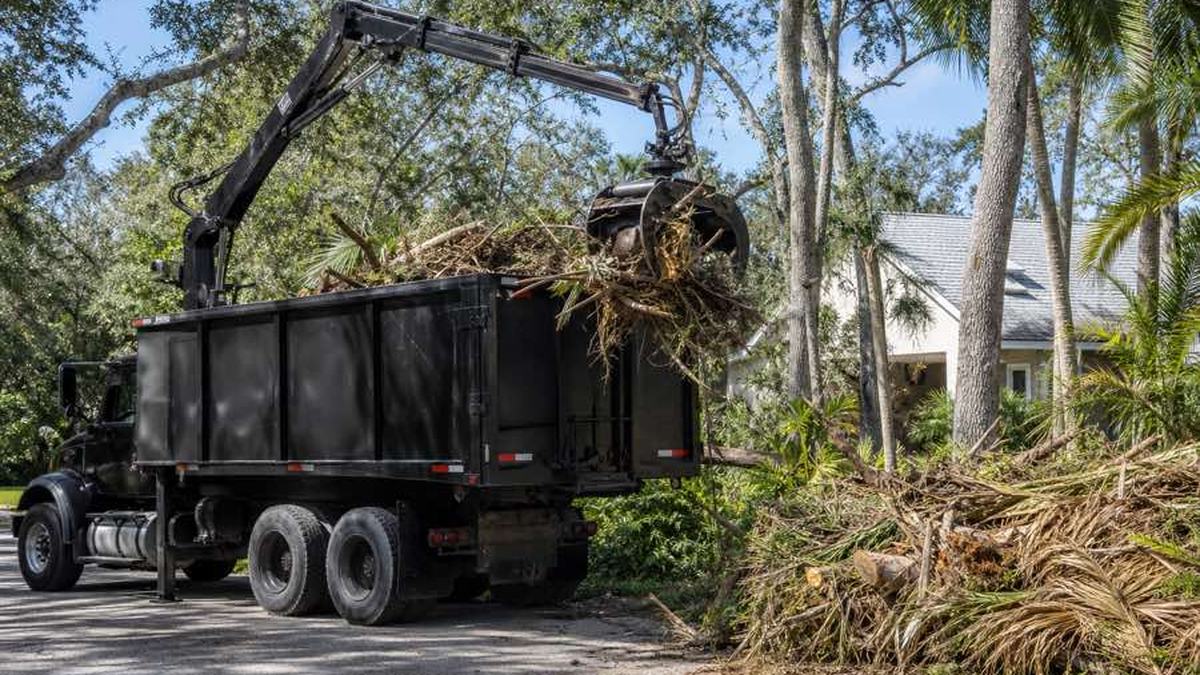
A grapple truck loads material with a mechanical arm, so reach matters. A pile hidden behind a fence, under overhead wires, beside a structure, or far across a soft lawn may not be safely accessible. The truck also needs an approach that can support a large vehicle and enough room to position without trapping other traffic.
A practical pile location generally has these characteristics:
Do not move material into a public right-of-way based on assumptions about storm collection. Current placement, collection, permit, and disposal instructions can change by event and jurisdiction. Check with the responsible authority. The Volusia County Solid Waste and Recycling page is an authoritative starting point for county information, though property owners should confirm which agency serves their address and material.
Keep vegetative debris separate from construction material, household waste, and questionable containers so the load can be reviewed accurately. The contact page is the right place to describe pile contents, and the storm debris cleanup hauling page outlines the service. Approved construction debris may be hauled only after confirmation, and hazardous or prohibited materials are not accepted on a blanket basis.
Mixed piles make identification and loading more difficult. They may also contain items that require special handling or a different destination. Before service, describe what is visible and disclose anything that could affect safe handling. Do not open, drain, burn, crush, or combine unknown containers in an attempt to make them haulable.
| Material group | Preparation approach | Important caution |
|---|---|---|
| Cleared branches, limbs, and brush | Keep together in an accessible pile after cutting and hazard clearance | No standing-tree cutting or removal is provided |
| Logs and trunk sections | Describe approximate dimensions and pile position | Heavy, unstable, or tensioned pieces require prior evaluation |
| Construction debris | Separate from vegetation and identify the materials | Hauling requires confirmation and approval |
| Household trash and loose contents | Keep separate and disclose them | Acceptance should not be assumed |
| Paints, fuels, chemicals, batteries, cylinders, or unknown containers | Leave undisturbed and contact the responsible authority | Do not place them in the hauling pile without specific confirmation |
The U.S. Environmental Protection Agency's natural disaster debris guidance discusses planning and waste-stream separation. It does not endorse Daytona Grapple Truck Service. Local acceptance and disposal requirements still need confirmation from the responsible solid-waste, environmental, or emergency-management authority.
Before dispatch, provide enough information to evaluate whether the truck can enter, position, load, and leave safely. Daytona Grapple Truck Service uses a 50-yard-capacity truck and serves Volusia and Flagler counties. Use the contact options to discuss the site and consult the full service area for geographic context. Capacity does not establish an exact load count for a particular pile.
Storm debris varies in density and shape. Tangled limbs can occupy substantial volume while weighing less than dense trunk sections or construction material. Moisture, soil, hidden items, load distribution, legal operating limits, and safe grapple handling can all affect what can be transported. For that reason, photographs and measurements are useful, but they should not be treated as a guaranteed load calculation.
When requesting hauling, be ready to provide:
Do not assume the truck can drive over a lawn, sidewalk, culvert, drain field, paver area, or saturated shoulder. Mention these surfaces during the initial conversation. Equipment reach must be considered together with ground support, overhead clearance, property boundaries, and a safe route out.
Resolving a blocked driveway may involve several separate roles: emergency agencies for immediate danger, utilities for lines and equipment, qualified tree or structural professionals for cutting and stabilization, and a hauler for cleared debris. Daytona Grapple Truck Service handles the hauling stage. Explore Port Orange service information and grapple hauling service details to plan that stage without confusing it with tree removal.
A clear sequence can prevent one contractor or agency from arriving before the site is ready:
FEMA publishes general debris removal guidelines intended to help communities manage post-disaster debris. FEMA does not endorse this business, and the guidance should not be read as a determination of eligibility, reimbursement, local pickup, or property-specific requirements. Contact FEMA and the applicable local or state authority for current official information.
Daytona Grapple Truck Service is based in Ormond Beach and provides hauling-only service across Volusia and Flagler counties. The phone is answered 24/7, but no specific arrival or completion time should be assumed. Calling early in the planning process can help identify what information is needed while cutting, clearance, and authority coordination are still underway.
These answers clarify the hauling role when storm debris blocking a driveway affects a Port Orange property. For service scope, review storm debris cleanup hauling; for property-specific access and material questions, use the contact page. Keep exclusion zones in place and resolve electrical, structural, cutting, and standing-tree hazards before arranging grapple-truck loading.
No. Daytona Grapple Truck Service is a hauling-only service. It does not cut or remove standing trees. Branches, trunks, and other vegetation must be cut, cleared of utility and stability hazards, and positioned for safe grapple access before hauling. A qualified tree professional or other appropriate provider should handle cutting and stabilization when those services are needed.
Stay away, keep others outside the area, and treat every line as energized. Do not touch the debris, line, fence, vehicle, water, or tool connected to the area. Contact the responsible utility and follow its instructions. Call 911 if there is an immediate threat to life or property. Hauling should wait until the utility hazard is officially addressed.
Approved construction debris may be hauled after confirmation, but it should be separated from vegetation and clearly described before service. Do not assume every construction material or mixed load is accepted. Identify roofing, lumber, drywall, metal, masonry, or other contents, and disclose paints, chemicals, cylinders, batteries, fuel, or unknown containers to obtain appropriate direction.
The truck has a 50-yard capacity, but that figure does not guarantee an exact number of piles or loads. Branch shape, log density, moisture, soil, mixed materials, safe loading, and operating limits affect capacity. Provide photos, approximate dimensions, material descriptions, and access details so the pile and truck positioning can be evaluated without relying on a volume estimate alone.
Port Orange is within Volusia County, which is part of the company's service coverage along with Flagler County. The phone is answered 24/7 for hauling inquiries, but no specific response time is promised. Service requires safe truck access, reachable and already-cleared debris, acceptable materials, and prior resolution of utility, standing-tree, structural, or emergency hazards.