August 21, 2026
Cut trunk sections require more planning than ordinary yard debris. Learn how access, staging, grapple reach, wood density, and site conditions affect hauling in Ormond Beach.
To haul cut tree trunk sections efficiently, the wood should already be cut, separated from obstacles, and staged where a grapple truck can safely reach it. Daytona Grapple Truck Service provides hauling only from its Ormond Beach service area. The company does not cut standing trees, perform tree removal, or prepare trunks for loading.
Large trunk rounds and logs are different from light branches. They can be awkward to grip, much heavier than they appear, and difficult to retrieve from confined yards. A useful plan begins before the tree contractor finishes cutting. Decide where the sections will be placed, keep the loading route open, and avoid mixing the wood with material that has not been confirmed for hauling.
The basic division of work is straightforward:
This hauling-only approach prevents confusion about who controls cutting methods, rigging, stump work, utility clearance, and the condition of any standing tree. Before arranging service, describe the approximate diameter and length of the trunk pieces, the quantity of limbs or brush, the staging surface, gate widths, overhead obstacles, and any materials mixed into the pile.
Good staging places cut wood on a stable, reachable surface with clearance around and above the pile. Review the local tree debris hauling service and use the contact page to discuss the pile before final placement. Trunk sections should not block traffic, drainage features, sidewalks, utilities, or access needed by neighbors and emergency vehicles.
Whenever possible, create one organized pile rather than several small piles scattered across a property. Keep logs and rounds visible instead of burying them beneath leafy brush. This helps identify bulky pieces and reduces the chance that unrelated items will be concealed in the load.
A practical staging checklist includes:
Public placement and collection requirements can change, particularly after storms. Volusia County publishes solid waste information through its Solid Waste and Recycling Division. Property owners should consult the county, municipality, road authority, utility, or other responsible agency for current rules rather than assuming a private hauling arrangement authorizes roadside placement.
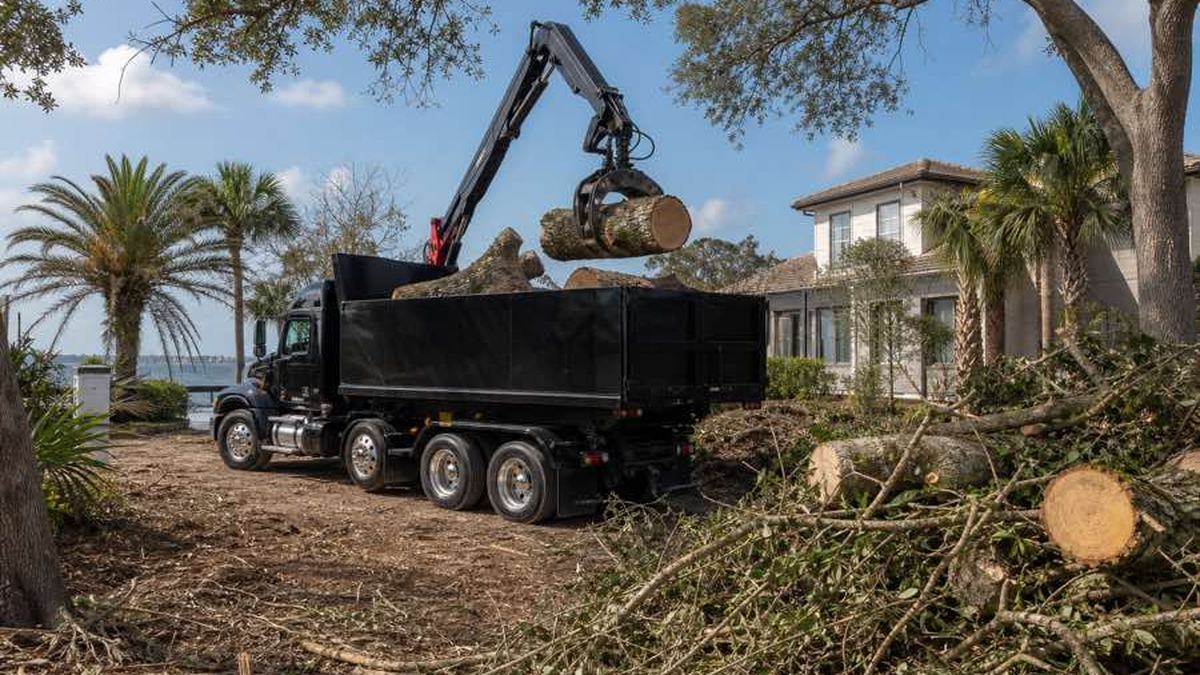
A grapple can lift debris without workers carrying every section by hand, but it still needs workable truck positioning and unobstructed reach. The grapple truck debris removal service depends on site access, while the broader service area covers Volusia and Flagler counties. A pile deep behind a home may be inaccessible even when it is visible from the road.
Reach is not simply the straight-line distance between the truck and the wood. Fences, parked cars, rooflines, overhead wires, soft shoulders, drainage swales, trees, and changes in elevation may limit where the truck can stand and how the grapple can move. A wide driveway also does not automatically provide a suitable setup if turning space is restricted or the surface is vulnerable.
Helpful details to provide before hauling include:
Keep public roads and shoulders in mind when planning access. The Florida Department of Transportation maintenance information is a starting point for state-road concerns, but FDOT does not govern every local street. Contact the agency responsible for the specific roadway for current permissions, restrictions, and maintenance questions.
Trunk weight cannot be judged reliably from a photo or diameter alone. Species, moisture, decay, embedded soil, section length, and branching all matter. Daytona Grapple Truck Service uses a 50-yard truck, as described within its grapple hauling service, but capacity does not establish an exact load count. Use the contact options to share dimensions and pile details.
Cubic-yard capacity measures volume, not weight. A truck body may have room remaining while dense, wet wood creates a significant weight constraint. Conversely, loosely stacked branches can occupy substantial volume without approaching the density of trunk rounds. For that reason, exact load counts should not be promised from a broad description such as “one large tree.”
| Variable | Why it matters | Useful information to share |
|---|---|---|
| Diameter | Thicker rounds usually contain substantially more wood. | Approximate width across the cut face. |
| Length | Long pieces may be harder to grip and orient. | Typical and maximum section length. |
| Moisture | Fresh or waterlogged wood can be heavier than dry wood. | Whether the tree was recently cut or has been exposed to rain. |
| Species or density | Different woods have different densities. | Species, if known, without guessing. |
| Contamination | Soil, concrete, metal, or other material can affect handling and acceptance. | Any visible attachments or mixed debris. |
Photos with a familiar object for scale can help communicate size, but they do not replace site-specific confirmation. Provide several angles, including the route from the likely truck position to the pile. Do not stand on unstable logs or enter a hazardous area to take pictures.
Daytona Grapple Truck Service does not cut or remove standing trees. It collects debris after another provider has safely cut or cleared it. Customers seeking post-cut tree debris removal can review that hauling scope, while the Ormond Beach service page explains the local coverage context. Separating these tasks keeps the hauling role clear.
Standing-tree work can involve tree condition assessment, climbing, rigging, chainsaws, controlled lowering, nearby structures, utility conflicts, and stump decisions. Those activities require a tree-work provider appropriate to the situation. The hauling company should not direct how a standing tree is cut or represent that it has assessed whether a tree is safe.
This distinction also affects scheduling. Hauling should be coordinated for after cutting is complete and the debris is in the agreed location. If cutting continues while a truck is loading, moving equipment and changing piles can create conflicts. A clean handoff gives the hauler a defined debris pile and a clear loading zone.
Before the tree contractor leaves, confirm that:
If a trunk or limb is touching a power line, structure, or unstable tree, contact the appropriate utility, emergency authority, or qualified tree-work provider. Do not attempt to reposition it for hauling.
Clean tree debris is easier to evaluate when it is not mixed with unrelated waste. Daytona Grapple Truck Service can haul approved construction debris after confirmation through its grapple truck service. Before combining materials, use the company contact page to identify each debris type. Do not assume every construction, storm, household, or potentially hazardous material can be accepted.
A trunk pile may contain more than wood after property clearing. Common complications include wire fencing grown into a tree, concrete attached to posts, landscape fabric, bags, soil, roofing, treated lumber, paint containers, batteries, fuel cans, and electronic waste. These items may require separate handling or confirmation from a disposal facility or responsible authority.
Use a simple sorting process:
After a natural disaster, debris programs and eligibility requirements may differ by location and event. FEMA's debris removal guidance offers general preparedness information, while the EPA provides natural disaster debris planning guidance. Neither source should be treated as confirmation that a particular pile, private service, reimbursement, or property is eligible. Contact the administering government agency for current instructions.
Once cutting is complete, gather clear information about the pile and access before requesting service. The phone for Daytona Grapple Truck Service is answered 24/7, and the contact page provides another starting point. Confirm that the property is within the Volusia and Flagler service area, then explain the wood dimensions, location, surface, obstacles, and any mixed debris.
A thorough description helps determine whether more information is needed. It does not guarantee a particular schedule, load count, or acceptance decision. Site conditions can change after heavy rain, additional cutting, utility work, or the arrival of other contractors.
Before the truck visit, complete this readiness check:
In Ormond Beach, sandy ground, drainage features, mature tree cover, narrow side access, and coastal storm cleanup can complicate staging. These are planning considerations, not assumptions about every property. Accurate photos and measurements are more useful than broad descriptions. Measure gate openings and section lengths when it is safe to do so, and clearly label which pile is intended for removal.
These answers summarize the hauling-only process for property owners who need to remove cut tree debris in the Ormond Beach area. Final suitability depends on access, staging, material type, section size, and weight considerations. For a specific pile, provide current photographs and an accurate description rather than relying on a general volume estimate.
No. Daytona Grapple Truck Service is a hauling-only service based in Ormond Beach. The company does not cut, dismantle, or remove standing trees. Arrange for an appropriate tree-work provider to complete cutting and clearing first. Hauling can then be considered after the trunk sections and other debris are on the ground and staged for grapple access.
There is no single section length that fits every property or pile. Diameter, wood density, shape, weight, grapple access, and nearby obstacles all affect handling. Ask the cutting provider to stage manageable, fully detached pieces, then share approximate maximum lengths and diameters with the hauling company for review before service is arranged.
Possibly, but visibility from the street does not prove reachability. The truck needs a suitable position, stable access, and clearance from roofs, fences, vehicles, trees, and overhead lines. Provide measurements and photos showing the pile and the route from the likely truck location. Deep backyard placement or narrow side access may prevent loading.
No. Fifty yards describes truck volume, while trunk sections may be limited by weight before all available volume is used. Moisture, species, diameter, length, soil, and other mixed material create uncertainty. An exact load count should not be assumed from photos or from the number of trees that were cut.
Approved construction debris can be hauled after confirmation, but it should be separated and identified first. Do not mix chemicals, liquids, batteries, fuel containers, unidentified waste, or other questionable materials into the wood pile. Describe each material when making contact so acceptance and staging needs can be considered before loading.